The timetable is full. But something is missing.
The questions young people are living with about identity, belonging, and the digital world don’t sit neatly within a single subject.
Across schools, leaders are beginning to recognise a gap between what students are experiencing and what education is currently structured to support.
How schools and trusts are using Lyfta
What Lyfta brings into schools
Lyfta is designed to support the space between curriculum content and student experience.
It combines immersive storytelling, structured reflection, and curriculum-aligned resources to help students:
✅ Explore real human experiences from around the world
✅ Develop critical thinking and perspective-taking
✅ Engage in meaningful, structured discussion
✅ Build a stronger sense of connection and belonging
This is how schools begin to address the gap between what students are living with and what learning is currently designed to support.
Want to go deeper?
See how trusts are responding to social and cultural challenges in schools.
Why this matters now
In many schools, the challenge is not a lack of content or curriculum time.
It is a growing gap between what students are experiencing in the world and what they are able to process within school.
When that gap widens, it begins to show up in subtle but consistent ways:
✅ Students engage unevenly
✅ Participation becomes harder to sustain
✅ Learning starts to feel less relevant or purposeful
Over time, this affects more than classroom behaviour. It shapes how students access learning itself.
This is the space Lyfta is designed to support.

Where trusts are focusing
Critical digital & AI literacy
Students are exposed to constant information, but not always equipped to question or interpret it.
Lyfta supports this by bringing real-world perspectives into the classroom, helping students explore complex issues through lived experiences rather than abstract content.
Diversity, Equity, Inclusion and Belonging (DEIB)
In diverse school communities, belonging doesn’t happen automatically. It has to be built deliberately.
Lyfta creates shared experiences that help students encounter different perspectives, reflect, and engage in meaningful dialogue.
See how schools are creating space for this →
Social & Emotional Learning (SEL)
Behaviour often reflects deeper needs and schools are shifting from reactive to proactive approaches.
Lyfta supports structured reflection and discussion, helping students process experiences and relate more thoughtfully to others.
See how St Mary's CofE Primary is strengthening wellbeing and self-regulation →
What we’re seeing across trusts
Here’s a snapshot of what’s emerging across the schools we’re working with:
✅ Learning that's grounded in real human experience drives engagement
✅ Structured reflection strengthens understanding and retention
✅ Trust-wide alignment improves consistency and equity
✅ High-quality, scaffolded resources reduce workload
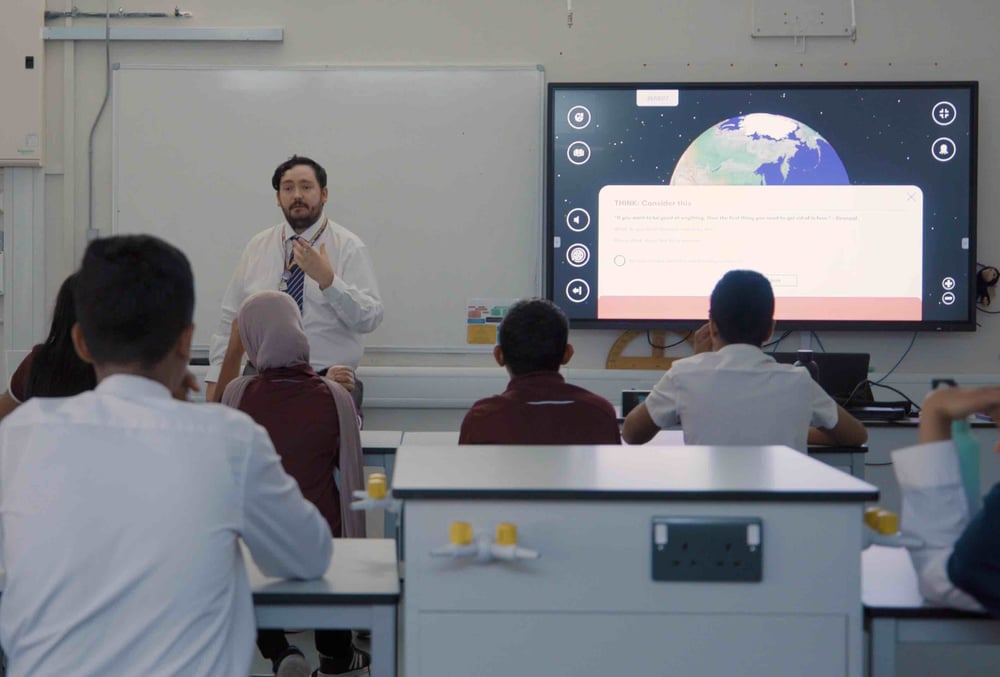
“We use Lyfta to regulate what’s going on in school… we’re all focused, calm, ready to move on to the rest of the day.”
Want to go deeper?
See how trusts are responding to social and cultural challenges in schools.
What this looks like in practice
Across Rochdale, Oldham, Barnet and Slough, schools are taking different approaches: Form time, PSHE, curriculum, and pastoral programmes.
But the shift they describe is consistent.
Students encounter real human stories.
They are given time to reflect.
And over time, something begins to change in how they think, engage, and relate to others.
See how a school in Watergrove Trust is applying this in practice.
Start with something practical
Many trusts begin by introducing simple, structured reflection into everyday school life.
Celebrating 10 Years of Lyfta
This year, Lyfta turns 10.
To celebrate our anniversary year, schools and trusts that join Lyfta on a long-term subscription can receive an additional 10 months free of charge.
If you’re exploring Lyfta for the new academic year, booking a conversation with our team in June means your school or trust may be eligible for the anniversary offer, even if implementation begins later in the year.
The offer is designed to support schools and trusts planning ahead for:
> belonging and inclusion
> pupil engagement and wellbeing
> oracy and communication
> personal development and cultural capital
> scalable, low-preparation teaching across the curriculum